
How to Start Fan Support (Oshikatsu) | 3 Key Decisions and Monthly Budgets
How to Start Fan Support (Oshikatsu) | 3 Key Decisions and Monthly Budgets
Fan support—the joy of backing your favorite person or series—is fulfilling. But when you're just starting, deciding \"how much and what to buy\" can feel overwhelming. When I made my first trip to an event, travel and accommodation costs doubled the ticket price, teaching me both the intensity of the fandom and the reality of everyday finances. Here's what to decide first.
Fan support—the joy of backing your favorite person or series—is fulfilling. But when you're just starting, deciding "how much and what to buy" can feel overwhelming. When I made my first trip to an event, travel and accommodation costs doubled the ticket price, teaching me both the intensity of the fandom and the reality of everyday finances. Here's what to decide first.
That's why I want you to lock in three things upfront: who or what you're supporting, how you'll support them, and how much you'll spend. Your monthly budget breaks down neatly when you split it into fixed costs (like fan club memberships or streaming subscriptions), variable costs (merchandise and café visits), and savings set aside for events and trips. Once you separate these, fan support becomes something you can sustain with joy rather than anxiety.
Different surveys show wildly different spending. One found the average at around 16,605 yen (~$110 USD), while another showed 72.8% spend under 5,000 yen (~$33 USD) monthly. These numbers are just reference points—not prescriptions. Once I wrote my monthly limit on paper, I could pause at the random badge display and actually breathe. In this article, I'll walk you through realistic budget splits for 5,000 yen (~$33), 10,000 yen (~$67), and 20,000 yen (~$133) monthly limits, covering what beginners don't need to buy first and what does matter.
The 3 Things to Decide Before Starting Fan Support
What Fan Support Actually Is
Fan support—the practice of backing your favorite person, character, or series in your own way—has no single right form. Some people watch broadcasts and streams. Others buy merchandise, attend events, or share thoughts on social media. Every form counts as fan support.
What beginners don't need to worry about is that the scope is bigger than you'd guess. It's not just idols and anime characters. Voice actors, VTubers, actors, athletes, and even entire series or teams count. There's no rule that you must attend in-person events to be a "real" fan, or that you have to prove your heat level. It all starts with one simple question: "Does something stir my heart?" That's it.
I've spent time in music-centered fandoms, and I've noticed something clear: even fans who love the same series follow totally different rhythms. One person chases every weekly stream. Another only makes the live shows. Both are doing fan support. Recognizing this early saves you from overextending before you even start.
推し活とは?推し方の種類や楽しみ方をわかりやすく解説!
www.trans.co.jpThe 3 Elements: Target, Style, and Spending Limit
Fan support has no "correct answer," but when you're new, there's so much information and so many products that your priorities can scatter. That's why three things work as anchors: what you support, how you support it, and how much you'll spend.
First is your target. Are you supporting one person, multiple people, or an entire group? Your information load and spending spread change based on this. The answer shapes whether you're chasing a single artist or following a whole franchise—and that distinction alone tells you what to buy and what to skip.
Second is your style. Watching and enjoying (we call this "viewing style") feels different from collecting merchandise, which feels different from attending live events. Each changes your monthly expense rhythm. If you're streaming-focused, your costs feel predictable. If it's merchandise, limited drops and random items shake your budget. If you're hitting events, you're looking at tickets plus transportation plus hotels—and that's where budgets usually blow out.
Third is your spending limit. Skip this step, and you'll love being a fan right up until month-end, when it gets painful. When I finally wrote down "I'm streaming-focused, maximum 8,000 yen (~$53 USD) per month," the confusion vanished instantly. New merchandise announcements would land, and I'd think: "Does this fit my style? Does this fit my budget this month?" Emotions don't disappear—they just get a proper place to land.
These three aren't complex blueprints. Your target shapes who you're backing. Your style shapes how you enjoy them. Your spending limit becomes less a brake and more a foundation for lasting joy. Everything that follows—the monthly budget breakdown—is just turning these three decisions into actual numbers.
Reading the Numbers Right: Average ≠ Recommendation
There are numbers floating around about fan support culture. For example, one major survey suggests the hobby involves 13.84 million people with a market size around 3.5 trillion yen (~$23 billion USD). These figures show fan support has grown into something far wider than a niche hobby. They're really valuable for understanding how widespread it is.
But here's the catch: these numbers shift depending on what counts as "fan support spending." That's why market estimates vary so widely.
Spending data works the same way. One survey says the average monthly spend is 16,605 yen (~$110 USD). Another finds that 72.8% spend under 5,000 yen (~$33 USD), and 32.9% don't spend anything at all. The numbers look totally different because the studies define "fan support" differently, ask different questions, and survey different groups.
⚠️ Warning
Average spending is a reference point—not a target. Different surveys use different definitions, so don't copy a number straight into your budget. It won't fit.
In reality, plenty of people keep fan support alive on under 5,000 yen (~$33) per month, especially if streaming and watching are your main focus. But once you add live events, one outing can cost 20,000 yen (~$133) or more for anime events, and 30,000–50,000 yen (~$200–$333 USD) for idol concerts. Add transportation and a hotel, and average-based planning falls apart fast.
So the real question isn't "What does everyone spend?" It's "What fits my style and my life?" If you're a viewer, 5,000 yen (~$33) can work beautifully. If you're mixing merchandise and streaming, 10,000 yen (~$67) sits comfortably. If events matter, you need to think about saving. The next section breaks down how to actually build those budgets.
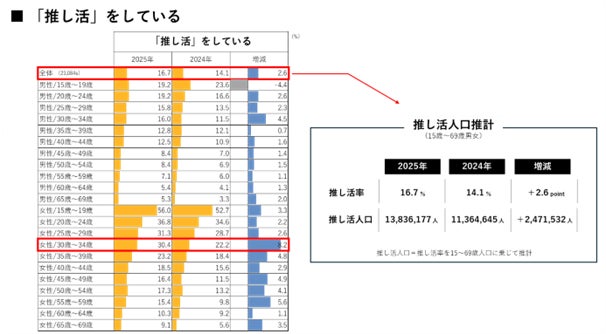
推し活人口は1384万人、市場規模は3兆5千億円に!第2回 推し活実態アンケート調査結果を公式noteで公開。
株式会社CDGのプレスリリース(2025年1月31日 10時06分)推し活人口は1384万人、市場規模は3兆5千億円に!第2回 推し活実態アンケート調査結果を公式noteで公開。
prtimes.jpFirst, Decide How You'll Support Your Favorites
Fan support shifts based on how you enjoy it as much as what you enjoy. Some people thrive on watching every new episode. Others light up collecting acrylic stands and badges. Some chase voice actor radio shows or watch VTuber streams in real-time. Others live for concert venues and the roar of a crowd. The different ways feel so different that early clarity helps you stop drifting.
When I say "viewing style," I mean centering your joy on watching and enjoying. "Advocacy" means spreading your favorite's charm across X, Instagram, or video platforms. "Group support" means backing an entire ensemble or series rather than one person. These words can sound similar, but what you spend—what you feel—changes completely. Locking down your style early keeps you from being swept away by every trend.
For beginners, the smoothest path is usually viewing style or curated merchandise focus. From there, you can step up—"I'll hit one event a year" or "I'm expanding to multiple favorites"—and your heat and life stay balanced.
Viewing Style
Viewing style centers on consuming the work itself: anime broadcasts and streams, voice actor radio or live broadcasts, idol free streams and fan compilations, VTuber broadcasts. You don't need mountains of merchandise. Every time you watch this week's amazing episode or catch that perfect voice acting moment, you're touching your favorite in your daily rhythm. That's the strength here.
For beginners, this is honestly the easiest fit. It's low-cost to start, and you get a real sense of your favorite's scale without diving deep. Surveys back this up: plenty of people doing fan support spend under 5,000 yen (~$33) monthly. A basic streaming subscription, maybe some related books now and then—your wallet doesn't take a hit. "This season, I'm watching these three shows," or "I'll just listen to the archived radio show," feels natural.
But viewing style has a flip side: time instead of money. You can end up chasing every related video, every fan comment, every archive—and suddenly you're refreshing your timeline every spare moment. Your wallet is safe, but your free time? That's on the line. Beginners can do this, but you need a boundary: don't try to catch everything.
Merchandise-First Approach
Merchandise-focused fans spend on things they can hold. Anime acrylic stands, badges, and plushies. Voice actor photo cards and concert goods. Idol light sticks and official photos. VTuber anniversary gifts and voice packs. The appeal is simple: you own a piece of your favorite. A single item on your shelf shifts your entire mood.
For beginners, this isn't a bad fit—if you can be selective. Here's why: merchandise adds up differently. One purchase feels fine. Then you're chasing random badge sets until you finally get your favorite character, and suddenly you're buried in duplicates. You think you're supporting the series, but before you know it, you're collecting by character, and your budget explodes. It happens more than you'd think.
What I tell beginners is this: pick one top item per category and stick to it. "For this series, I'm only collecting acrylic stands. For that idol, I'm only buying live recordings. For that VTuber, just birthday merchandise." Once you narrow the target, your buying decisions get sharp. It's a good next step from viewing, but beware: if collecting becomes the goal instead of the appreciation, you'll spend more time managing your shelf than enjoying your favorite.
Event-Centered Approach
Event fans find magic in being there. Anime preview screenings and talk events. Voice actor live shows. Idol concerts. VTuber real-world events and festivals. The screen can't capture it: the buzz before the lights drop, the moment the opening hits, the energy of a whole crowd reacting together. Some experiences only exist in the room.
But let's be real: it's steeper for beginners. A ticket isn't the whole cost. Add transportation and a hotel, and even anime events can top 20,000 yen (~$133). Idol concerts run 30,000–50,000 yen (~$200–$333 USD). Toss in travel, and costs soar fast. This is the catch many people miss at the start.
I've had periods where I chased every show I could reach. My spending went crazy. Some months, travel cost more than the ticket itself. Now I've settled into "streaming plus two big events a year," and I keep the heat while keeping my monthly costs steady. The event experience is intense, sure, but newcomers do better starting with "maybe one big show a year as a special treat" rather than trying to catch everything.
Social Media and Advocacy
Some fans pour their joy into words. Advocacy isn't a hard sell—it's sharing what moved you. "This episode's direction was perfect." "This voice actor's singing needs to be heard." "This VTuber's streams are beginner-friendly." It can be an X post, a short video, or a stream highlight thread. It's the fan support style built on putting feelings into language.
Money-wise, this is easy to start. But personality matters. If writing feels natural, or if you love recommending things to friends, this clicks for you. Anime readers probably imagine it: weekly episode thoughts, voice actor news roundups, song setlist reactions, VTuber beginner guides. Makes sense, right?
Here's the trap: obligation kills joy. When you start chasing clever phrasing or obsessing over engagement numbers, watching becomes secondary to performing. The character matters less than the metrics. This style has real power for people whose love naturally becomes "I have to share this"—but for beginners still learning what moves them, it's a lot. Try writing the occasional one-liner reaction while you're watching. That's enough to start.
Multiple Favorites / Group Support
Multiple favorites means what it sounds like: you're not limiting yourself to one. Group support means backing a full ensemble or series instead of one character. With anime, that could mean the whole show instead of just your favorite character. With idol groups, maybe you love all five members, not just one. With VTuber agencies like Hololive or Nijisanji, you care about the whole crew.
The beautiful part? Your enjoyment multiplies. You see combinations and dynamics you'd miss with just one. "This person's voice paired with that person's energy" becomes its own kind of magic. Group support takes the fun from "I love this person's voice" to "I love this lineup" to "I love this team's vibe."
But for beginners, it's a step up. Your information load doubles (or triples). One favorite means one type of merchandise. Multiple mean more kinds to chase, more events to track, more budget to split. Your feelings grow richer, but your planning gets harder. Start with "basically one favorite, but I also love the series" and let group support grow naturally from there. It usually does.
💡 Tip
Stuck on where to begin? Spend your first three months in viewing or merchandise-focused mode. Then branch into events or group support. Your enthusiasm stays focused that way.
Setting Your Monthly Limit
Here's the real trick: think about what's left over, not what you want to spend. After rent, food, phone bills, and basics are covered, what's still yours? That remainder is where fan support lives. If you chase the feeling first, a big event or new merchandise launch will wreck your balance in one month.
Some financial advisors talk about the "10–20% of income" rule. That's advice, not law. Fan support costs completely change based on your style. Do you watch mostly? Are merchandise and streams your thing? Do you hit live events? A real limit comes from life-fit, not from averages.
When I set my limit, I aim for "what works every month, not just when nothing's happening." I need it to hold steady even if something new drops or if I want a few extras. Then I split it into fixed costs, variable costs, and savings.
Fixed Costs (Fan Clubs, Subscriptions, etc.)
Fixed costs are the recurring expenses that "book your seat": fan club memberships, streaming subscriptions, anime platforms, channel memberships, periodic magazine subscriptions. If you're unclear here, invisible charges creep into what you thought was free money.
The easy miss is annual fees. Fan clubs usually bill yearly. Update months feel like sudden hits. But honestly, you've been paying all year—you just see it in one chunk. Once I started breaking my club membership into monthly amounts on my budget, the "why is May so red" feeling vanished. I was already using the money over twelve months; seeing that monthly made it real.
So if you have one anime streaming service, one music subscription, and one fan club, convert all of it to monthly costs and put it in fixed expenses. But only keep subscriptions that are genuinely core to your fan life. Don't drag along services you barely use—they eat into variable spending and savings space. Lock down the subscriptions that truly matter, so you can see your free money clearly in the second half of the month.
Managing Variable Costs
Variable costs are the fun stuff—the month-to-month joy. Merchandise, café collaborations, books, films, random items, anniversary drops. This is where you see fan support happening. But it's also where budgets crack most easily.
The trick isn't a hard spending ceiling; it's writing down your rules. "One item per category," "I replace acrylic stands, don't stack them," "I limit random badges," "No double purchases without display space," "Do I use this? Will it replace something I already own?" These rules aren't buzzkills. When new merchandise drops and you feel that pull, these rules let you choose, not just react.
When I'm torn over a purchase, I ask myself: "Will I actually use this? Does it replace something I already have?" It's okay to buy something just because it's cute or it's a special release—absolutely. But when your shelf starts burying duplicates, the satisfaction shifts from "I adore this" to "I'm drowning in stuff." Smart variable spending isn't zero spending. It's chasing the purchases that actually light you up.
⚠️ Warning
Variable costs work better when you "make one the star of the month" than when you "spread yourself thin." Merchandise month, café month, film month—rotating focus keeps spending cleaner.
Savings is the emotional lifeline of fan support. Event costs don't stop at the ticket. Add transportation, a hotel, food at the venue, and merchandise—local events can hit 20,000 yen (~$133), and idol concerts run 30,000–50,000 yen (~$200–$333 USD). That's way more than one month's variable budget can absorb.
So if events are even a maybe, build savings into your monthly budget from the start. It's simple: part of your monthly limit is money you don't spend yet. If events are your main thing, save more. If viewing is your focus, save less. The key is never scrambling for cash after you win a lottery draw.
I used to panic the moment I got a ticket confirmation—suddenly doing math on how to afford travel. Now I have savings waiting, and when the email arrives, I can think clearly: "Can I actually do this?" Heat doesn't override good planning. Savings make the difference between a magical event and a stressful one.
Here's one example (it's my approach, not data-backed):
| Monthly Budget | Fixed | Variable | Savings | Best For |
|---|---|---|---|---|
| 5,000 yen (~$33) | 1,500 yen | 2,000 yen | 1,500 yen | Viewing, casual support |
| 10,000 yen (~$67) | 2,500 yen | 4,000 yen | 3,500 yen | Streaming + curated merch |
| 20,000 yen (~$133) | 4,000 yen | 7,000 yen | 9,000 yen | Events and travel |
The 20,000 yen (~$133) plan targets people who want events woven into regular life. That's about 240,000 yen (~$1,600 USD) yearly—room for multiple events or trips. But you'll need fat savings. Treat event costs (tickets plus travel plus hotels) as one bucket, not separate pieces. If merchandise is your jam, pump variable spending higher. For event lovers, stack that savings even deeper. Same 20,000 yen (~$133), totally different shape.
Viewing fans: put weight on fixed costs (the streami subscriptions), light on variable, thin on savings. Merch fans: trim fixed, make variable the star. Event fans: savings first, then variable for the moment itself. Your monthly amount matters less than where you point the volume. Once you split spending and saving, fan support stops being about what you can't do and starts being about what you design.
What Beginners Should Prioritize (and What Can Wait)
Spending to Prioritize
Beginners should spend on the foundation for following your favorite: cost to track official news, then access to watch or listen, then carefully chosen merchandise. Fan support runs on frequency of contact more than quantity of stuff, so don't start with a shopping spree. You'll lose your footing faster that way.
Tracking official news means fan clubs, official apps, membership services. But here's the thing: "it's official, so I join everything" is wrong. Does it matter for your actual fandom? Are there exclusive streams? Is all the news there? If yes, it's worth it. If you can track everything free through official social media, there's no rush to add fixed costs. Lean light early on.
Next comes watching and streaming. Anime, concert films, radio archives, show recordings. This is where your daily heat lives. Touching your favorite through watching keeps you connected without huge spending. You're basically buying access to the content itself. That's the closest you can get to the source. Build your viewing setup first. It seems like the long way around—it's actually the shortest path to your favorite.
Then merchandise. But "curated" is the keyword. Acrylic stands you have shelf space for. Badges where the art hits different. Shirts you'd actually wear. Not everything. The trick to beginner merchandise joy is matching what you buy to how satisfied you'll feel. Missing out on a random drop is way healthier than buying blind, taking it home, and feeling "ehh."
Event costs are big priorities too, but different. Don't pull from your monthly spending. Use those savings waiting in the background. Once you've saved enough, you can decide calmly: "Can I actually do this?"

推し活にかけるお金はどれくらい?活動別の平均金額やうまくやりくりするコツをご紹介 | 推し活・オリジナルグッズの企画・製造・販売ならJ&Cサプライ株式会社
「大好きな推しを思う存分応援したい!」誰もがそう思う一方で、「推し活にはお金がかかるし、実際どれくらい使っているか不安」という方もいるのではないでしょうか。この記事では、推し活に皆さんが使っている平均金額をご紹介します。また、推し活費をやり
jandc-supply.comSpending That Can Wait
What can wait is spending where the overhead outweighs the core joy. Transportation and hotels are the classic examples. Being there is intense, yes. But travel costs aren't money going to your favorite—they're going to infrastructure. Beginners do better leaning on nearby events and streams, not chasing across the country. Your wallet and your satisfaction stay healthier.
I made this mistake early. I'd see a ticket and think "I can afford this," then watch travel costs balloon and feel the regret. Trips reshape your overall budget. So the early move: use early-bird deals, pick nearby shows, consider day trips. Save the long-distance events for when your savings stack matters.
Event spending itself shouldn't auto-lock into "I go to everything." Especially early on, you'll apply for lotteries and feel the heat when you win. After the joy comes reality: the full price, the travel, the stuff you'll buy onsite. Beginners who sit with that reality before committing find it easier to say "Not this time."
And beware the spectacle trap. "I should buy something at the venue." "This is a commemorative moment, so I'll grab extras." The venue energy is real—it makes empty-handed feel wrong. But once you're home, satisfaction comes from liking what you have, not having stuff. Clear priorities mean postponed spending becomes "this wasn't for me right now," not "I gave up."
Random Items and Ruled Approach
The biggest budget-breaker for beginners is random merchandise and bulk buying. Random badge sets, blind key chains, trading cards. The thrill of opening is electric—but satisfaction depends on luck. And because each piece is cheap, you don't see the total until the damage is done. Suddenly your streaming money vanished into a pile of stuff you don't love.
I once thought buying random badges in bulk would land my favorite. It didn't. My desk just filled with opened packs and regret. Not the regret of buying—the regret of not stopping. Once I made a rule: "Maximum three of this item," my satisfaction shot up even though I spent the same. Rules make luck matter less.
Random items kill you when it's a yes/no choice. Instead, set a frame first. Quantity limits, art conditions, or a special "random budget" within variable spending. That way, even when you want to grab everything, your decision-making stays clear. Some fandoms have trade cultures where pulling a few gets you trading material—different math. Or you realize the hassle of trading isn't for you. Both are smart choices.
ℹ️ Note
Random items: don't chase "hit the favorite." Stop at a number where you're happy regardless of what opens. That's how you protect your budget.
Bulk buying carries the same trap. Buying more doesn't equal deeper love. Beginners especially mix "having more" with "being more satisfied." Real stability comes when you figure out what spending actually makes you happy. Setting random-item rules isn't just wallet protection—it's you learning what your own fan support looks like.
Money Management Tips for Long-Term Fan Support
Front-Loading Savings and Dedicated Accounts
The strongest move: don't save leftovers, split money upfront. Payday arrives; that day, move "fan support savings" to a separate place. Keeping it in your main account makes the money blur into rent and groceries, and suddenly you don't know what you can actually spend. Everything gets fuzzy.
Once I opened a fan-only account, the noise stopped. I could see savings at a glance. What's waiting, what I can use—clear lines. Before, I'd see merch news and do math in my head ten times: can I? should I? With the separate account, that math disappeared. I know the number. The guilt and rush just... evaporated.
Your method doesn't have to be a bank. Cash in envelopes works. A budgeting app works. Even a note on your phone works. The real move: split into fixed, variable, and savings from the start. Fan club and streaming go to fixed. Merch and cafés go to variable. Event cash goes to savings. Month-end comes, and you see exactly what inflated—or you see it's all as planned.
A lot of money guidance talks about front-loading—make it automatic, make it invisible. Apply that to fan support. Build the structure quietly. Then when news drops or lotteries hit, you can feel the joy without the financial whiplash.
推し貯金のすすめ!推し活・オタ活資金をためるルールや節約術|mycard|三菱UFJニコス
www.cr.mufg.jpAuditing Fixed Costs Before Renewal
Budget breaks don't always come from impulse buys. Often it's fixed costs. Fan clubs, video platforms, music streaming, e-books, channel memberships. Each is tiny. Together, they're steady pressure.
The real audit: overlap. You signed up for a service to watch archives, and now you barely open it. Another service does the same thing. You're paying for two. These aren't about love—they're about autopilot, and they squeeze your budget.
Before you trim variable, trim fixed. If a subscription isn't pulling its weight, the healthier move is to drop it than to say no to merch you actually want. Fan club renewals? Look at what you're actually using. Early access you don't chase. Exclusive content you never open. Perks you don't care about. Renewal month is the moment to be honest: is this still worth it?
The issue: fan support gets expensive across the board. Clubs, merchandise, events, travel, café collaborations. Once it all stacks, the numbers get hard to read. But fixed costs are the foundation. If the base is too heavy, your event money and merch space disappear. Trim here first, and the rest gets clearer.

推し活に使うお金は月平均16,605円!1,000人の推し活事情を調査
推し活にかけるお金について1000人に調査し、月平均やお金を惜しまないものなどをグラフ化!推しの分野による違いも比較・分析しました。調査の結果、推し活にかけるお金の月平均は16,605円とわかりました。
www.dai-kokuya.co.jpTravel Hacks: Transportation and Hotels
For event fans, the real cost comes after the ticket: travel and lodging. Transportation isn't about love—it's logistics. That's where you actually have room to save without losing the feeling.
Early-bird discounts hit hardest. Shinkansen, flights, buses—book as soon as dates are set. I saved 6,000 yen (~$40 USD) round-trip with early pricing. That wasn't painful. It went straight to next time's savings, which felt like borrowing from future-me instead of scraping from now-me. Savings make sacrifice disappear.
Discount passes, carpool splits, transit passes—compare before one-offs. For group outings, splitting rideshare from hotel to venue saves money. Hotel hunting? Don't just chase luxury. Ask: Can I get there? Will I make the start time? Will I have enough money left for a taxi if I'm wrong? Choose based on logistics, not ratings. The difference between a nice hotel and a cheap one gets eaten by stressed travel anyway.
Day trips when possible. Skip the drive to distant events, and grab nearby ones. More events close to home, fewer exhausting trips. Your budget spreads further, and you stay fresher for the actual experience.
Rules for When Spending Overshoots
Your budget won't always hold. That's normal. What matters is what happens next.
Make a rule before it breaks. "Overage this month? It comes from next month's variable." Or "Overshoot once? Next month I pause one category—no merch or café, pick one." Or "Dip into savings? Top it back up first thing next month." Rules before overages mean you recover instead of spiraling.
Here's the powerful part: put "choosing to skip" in writing. "This month I'm sitting out random badges." "Event month, so I'm selective at the venue." "Same artwork? I'm not buying doubles." It might feel like limiting joy, but the frame becomes permission to breathe. You're not depriving yourself. You're being intentional.
ℹ️ Note
Overage rules work better than apologies. Know exactly how you'll bounce back, and you won't spiral. One misstep stays one misstep.
One survey found only 39.4% of fan supporters set a monthly ceiling. Flip that: most people run with no limits. So you're already ahead just by deciding this. And if you nail the recovery plan too? You're running circles around the chaos.

「推し活にかけるお金と節約に関する意識調査」を実施!~7割以上が推し活に使うお金が「月5,000円未満」と | しっかり保険、ちゃんと節約。
株式会社エイチームのグループ会社である株式会社エイチームフィナジー(本社:愛知県名古屋市、代表取締役:間瀬文雄)は、「お金の不安を解消する」メディアのナビナビ保険(現:しっかり保険、ちゃんと節約。)にて、15歳以上の男女約450名を対象に「
www.navinavi-hoken.comThe Non-Negotiable: No Debt, Life First
This one's worth its own line. Don't borrow to be a fan. Don't strip your life to save. Don't use credit cards, buy-now-pay-later, or long-term financing. Those tools turn a moment's joy into months of weight.
Events and sales pressure you with deadlines. "Ends today." "Lottery closes." It's real tension. But that moment shouldn't hijack your payment method. Money you don't have, borrowed against next month's life—that joy becomes regret.
The experience you attend on borrowed funds, the merch you bought by cutting grocery money—they carry shadows afterward. Fan support is supposed to add light, not steal from your foundation. If your choice doesn't include "my rent and food stay safe," then it's not a choice yet.
Event expenses are thick. Tickets, travel, hotel, food, shopping—it stacks. That's exactly why advance savings matter. The beauty of that savings fund is you never panic-borrow. You're building capacity. That feels totally different.
Common Questions
Do I Have to Pick Just One Favorite?
No. Multiple favorites are completely normal. Anime, idol groups, and other fandoms see people supporting different people or characters, and that's healthy. Some people divide attention equally. Some lean heavy on one "main" with lighter support on "secondaries." The issue isn't the number—it's having a rule.
I've done multi-favorite phases, and the moment I set a ratio (like 70% main, 30% secondary), the guilt vanished. My main got real heat. My secondary got genuine love. Without the ratio, I'd ping-pong between "I'm neglecting this one" and "I'm overspending on that one."
Multiple favorites aren't scattered if you set boundaries. They're actually clearer because you know your allocation. The frame makes it work.

5人に1人がやっている「推し活」とは?意味と活動内容を解説|オリジナルグッズの【マイシュミ】
オリジナルグッズが1個~簡単&格安で!金額と納期はHPで分かるから安心&問合せる手間ナシ。便利なシミュレーターでデザインも簡単。スマホケース、マグカップ、Tシャツ等が誰でも楽々つくれる!
myshumi.designHow Much Is Safe to Spend?
Start from life, not numbers. What's left after rent, food, utilities, and responsibilities? That remainder—that's your space. If fan support comes before survival, the joy will be crushed by reality by month-end.
Financial advice mentions "10–20% of income," but that's loose guidance, not law. What you actually need shifts wildly based on your approach. Viewing fans need less. Event fans need more. The number that works is the one that leaves your life standing.
Use yearly math to get a feel. 5,000 yen (~$33) monthly is about 60,000 yen (~$400 USD) annually. 10,000 yen (~$67) is roughly 120,000 yen (~$800 USD). Some financial surveys suggest yearly averages around 120,841 yen (~$807 USD)—that's a 10,000 yen (~$67) monthly frame with room for both merchandise and one or two events. But that's average. You're not average. 5,000 yen (~$33) a month is also real money over a year, completely valid. And less is fine too.
Is It Really Fan Support Without Spending Money?
Yes. Watching episodes, following streams, writing thoughts online, listening to favorite songs, posting birthday wishes. All of that counts. Spending doesn't measure love.
One survey found 32.9% of fan supporters don't spend money at all. That's not weird. That's common.
Watching and sharing your thoughts brings its own rhythm. Not the sudden burn of a concert, but a quiet, steady warmth woven through daily life. I've had periods without event access, and my support didn't weaken—it shifted. Writing short reactions became the real connection. Heat stayed even without spending. It was different, not smaller.
How Do I Split Budget Between Multiple Favorites?
Set a total ceiling first, then divide. Work backward. If you reverse it—"a little for each, totaling nothing"—the outline disappears. Front-load the number. Then split equally, or weight your main favorite heavier if your engagement actually varies.
Your style matters. If main-favorite means events and merch, secondary means streaming only, then equal spending makes no sense. Different roles need different amounts. Second favorites grow naturally once you lock the frame.
Event-heavy months hit different. Don't expect monthly spending to handle everything. Use that savings bucket. Flat months build it. Heavy months empty it. Multiple favorites get easier with advance savings, not monthly cash flow.
ℹ️ Note
Multiple-favorite muddle usually comes from unclear priority, not wrong amounts. Set priorities first, then numbers snap into place.
Different for Students vs. Working Adults?
Yes, the shape changes.
Students have tight money and loose time. Start small—under 5,000 yen (~$33) monthly, maybe. Watch, grab small items, build tiny savings. That's about 60,000 yen (~$400 USD) yearly, which isn't negligible. Daily rhythm matters more than big event counts. Find the groove early, and the habit lasts.
Working adults have bigger budgets but bigger fixed costs (rent, insurance, surprises). Just because income grew doesn't mean fan support should expand past your safety net. Protect fixed costs harder. Build event savings fatter. More income means more room, yes—but also more things competing for that room.
Students: "start small and sustain." Adults: "design the frame before it spreads." Same hobby, different wisdom.
Summary | Set Rules Before the Heat Takes Over
Here's your action list for today:
- Write down how you'll support your favorite
- Decide this month's limit
- Split it into fixed, variable, and savings
- Pick one way to track it (app, notebook, whatever)
- Track for a month, then revisit
ℹ️ Note
- Related article candidate: The Basics of Fan Support (Budget Building Fundamentals)
- Related article candidate: Event Savings Strategies (Travel and Lodging Hacks)
Related Articles
What is Anime Music? Understanding OP, ED, Inserts, and Scoring
What is Anime Music? Understanding OP, ED, Inserts, and Scoring
Anime Music Artists Explained | Understanding Voice Actors, Dedicated Anison Artists, Bands & Tie-up Artists
Anime Music Artists Explained | Understanding Voice Actors, Dedicated Anison Artists, Bands & Tie-up Artists
How to Choose Between Subscription and Purchase | 5 Decision Axes
How to Choose Between Subscription and Purchase | 5 Decision Axes
RPG/Action/ARPG Differences and How to Choose | Beginner's Guide