
Digital vs. Paper Manga: A 5-Axis Comparison and How to Choose
Digital vs. Paper Manga: A 5-Axis Comparison and How to Choose
When it comes to manga, the question of digital versus paper has a surprisingly clear answer in Japan. If convenience is your priority, digital wins. If you value the sense of ownership and the impact of full spreads, paper is stronger. When in doubt, combining both approaches tends to feel most satisfying. Read one chapter on your commute, buy the next volume on your phone before bed, and display only your favorite series on your shelf—this kind of flexibility makes the choice far more practica
Is digital or paper manga better? The answer is fairly clear: choose digital for convenience, paper for ownership and spread impact, or both if you're torn. This approach tends to feel most satisfying.
Reading one chapter on your commute, buying the next volume on your phone before bed, displaying only your favorite series on your shelf—this kind of flexibility makes the choice far more practical.
This article walks readers through five axes—reading experience, cost, storage, ownership, and accessibility—in a balanced way. It's designed for people building a manga collection for the first time, or for those wavering between digital and paper formats.
Digital vs. Paper: The Quick Answer
If you read a lot, buy impulsively, or want to save space, digital is strong. One smartphone holds dozens or hundreds of volumes. You can buy the next installment at midnight without waiting. Pricing is often competitive when you factor in promotions and first-purchase coupons.
If you care about the feel of ownership, shelf aesthetics, and spread impact, paper wins. The moment you open a volume, spreads hit naturally. Shelves lined with spines feel good. Special editions, dust jackets, and collectible appeal remain unmatched.
Torn between the two? Digital for daily reading, paper for favorites. This hybrid is the most honest answer. High-volume readers often gravitate here naturally. Streaming lets you chase current installments guilt-free, while keeping only your treasures on paper feels less wasteful.
The Five Comparison Axes
Price, storage, readability, ownership, and risk divide cleanly. Price: Digital isn't cheaper per copy, but sales and coupons stack. Paper can't compete on new releases, but used markets swing the advantage back. Storage: Digital needs nothing. Paper compounds as volume grows. Readability: Depends on device size. Spreads suffer on phones (6.8 inches), shine on tablets (10+ inches), and feel best on paper. Ownership: Paper brings tangible satisfaction—dust jackets, spines aligned, special editions in hand. Digital offers no equivalent. Risk: Devices change. DRM restricts. Paper faces water, dust, and age.
Market data underscores the shift. The 2024 comic market hit ¥704.3 billion ($4.7 billion USD), with digital commanding 69.6% versus paper's 30.4% (2023 figures). That dominance signals convenience: readers have chosen digital. Yet the 30% holding steady suggests paper hasn't vanished. Instead, use-case splits.
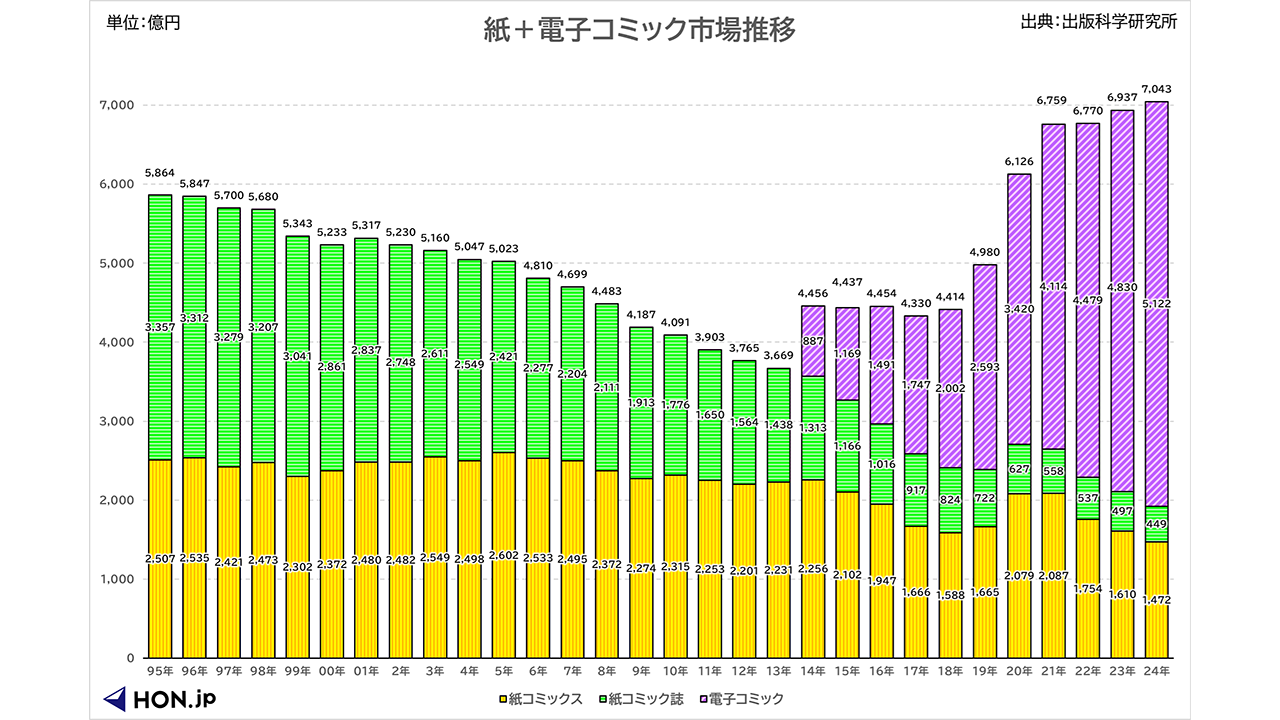
2024年コミック市場は7043億円 前年比1.5%増と7年連続成長で過去最大を更新
Japan's comic market reached ¥704.3 billion in 2024, growing 1.5% year-over-year for the seventh consecutive year. Digital now accounts for the majority.
hon.jpDigital Manga: Strengths and Limits
Why Digital Works
Storage vanishes. Shelves aren't needed. Moving house costs nothing in data weight. Fifty-volume series fit invisibly in your pocket.
Portability is unbeatable. Your entire library rides one phone. Read one chapter on the train, jump to the next arc at lunch, continue before bed—unbroken flow. Paper forces you to decide which volumes to carry.
Immediacy thrills. Finish a volume at night, buy the next in seconds. No bookstore hours, no shipping waits. That momentum feels almost essential to binge-reading.
Discounts and coupons stack. First-purchase bonuses, seasonal sales, and point rebates compound in ways paper can't match. Bulk purchases compress significantly. Price-per-volume doesn't always favor digital, but the entry point usually does.
Out-of-print access improves. Works that vanished from shelves often remain available digitally. Less hunting, faster acquisition.
Features streamline reading. Search, bookmarks, zoom, annotation—all make revisits and navigation easier. Want to find a scene? Faster on digital than flipping through paper.

Electric comics services name their 2025 trends
Digital comics continue expanding as convenient entertainment.
xtrend.nikkei.comThe Catches
Spreads flatten on small screens. Phones force single-page display. Information density drops. Composition impact fades. That full-page gasp the artist designed for vanishes.
Image quality varies by service. DMM Books, BookLive!, Comic Seymore—each compresses or tunes output differently. Line sharpness, ink solidity, color tone all fluctuate. Paper remains consistent across copies.
Ownership is partial. DRM|Digital Rights Management kicks in. Files don't transfer freely. Some platforms lock you into apps; others offer limited export. Amazon KDP clarified in January 2026 that DRM-free works can be downloaded by buyers—but this applies only to KDP titles, not industry-wide. Service-to-service rules diverge. You're leasing, not owning.
ℹ️ Note
DRM protects against piracy, but from a reader's perspective it means: "My purchase has usage limits." That's fundamentally different from shelving a physical book.
Service changes happen. App updates, account overhauls, business decisions—these shifts never affect paper. Digital can shift overnight.
Device Size Matters More Than Format
Smartphones (6 inches) offer speed and convenience. Single-page reading flows. Commute-friendly. But spreads compress; fine details blur.
7–8 inch devices (Kobo, iPad mini) balance portability with screen space. Single pages read comfortably. Spreads remain cramped.
10+ inches (iPad at 10.86", Fire HD 10 at 10.1") unlock landscape spreads. Dialogue reads naturally. Zooming drops sharply. Trade-off: weight increases; handheld endurance decreases.
E-paper (6–7 inches) like Kindle Paperwhite feels gentle on eyes, excels at reflective reading in daylight, but suits single-page manga. Large E Ink models shift the balance slightly.
The takeaway: digital reading isn't monolithic. A phone, a 7-inch reader, and a 10-inch tablet each feel like different formats. Digital's convenience varies wildly by device.
Paper Manga: Strengths and Limits
Why Paper Endures
Ownership feels real. Dust jackets, spines, limited editions—tangible objects bring satisfaction. Shelf arrangement becomes art. This joy resists digital replacement.
Spreads sing. Open a volume; full-page compositions hit immediately. Panel flow follows naturally. No zoom needed. The turning of pages adds rhythm. Action and scope feel most alive on paper.
No power required. No apps, no logins, no connectivity. Grab a volume anytime. This simplicity is security.
Sharing is effortless. Hand a book across the table. Children and housemates read without accounts or explanations. Paper circulates naturally through families.
Physical intimacy matters. Fresh-printed ink, textured cover stock, weight in hand—these sensations create memory. Music buffs feel this between playlists and vinyl. Paper manga has that tactile presence.
The Burdens
Physical costs accumulate. Room, shelving, moving—each volume adds weight and bulk. Fifty-book series consume a shelf. Paper becomes a logistics problem.
Deterioration is real. Sunlight yellows. Humidity warps. Read-wear marks covers. Preservation requires care—a hidden tax on collection.
Searching is slow. "Which chapter had that scene?" Paper means paging through. Digital finds it in seconds.
Disposal is hard. Selling back, donating, or recycling demands effort and choice. Emotional weight multiplies as collections grow.
New hardcovers cost. The average manga volume in Japan runs ¥1,332, up 2.1% year-on-year (2024). That gap compounds.
Used markets aren't infinite. Some series lack secondhand copies. Others are out-of-print. Digital supply often surpasses paper availability.

2024 Publishing Market Shrinks Again; E-Comic Share Keeps Rising
Japan's publishing market declined 1.5% to ¥1.57 trillion in 2024. E-comics now represent 36% of all e-publishing.
book.asahi.comUsed Markets and Collectible Strategy
Paper's secret weapon is the used market. Buy new spreads your favorite series. Sell or donate when done. Complete sets drop 30–50% used. Combine that with patience and paperback reprints, and series become affordable. Digital promotions dazzle at the start; paper savings compound over time.
Limited editions and variants sweeten paper's appeal. Alternate covers, art cards, special binding, reprinted hardcovers from years past—these "physical differences" can't be replicated digitally. Many hybrid readers buy digital first, then grab special editions in paper. That's not wasteful; it's strategic.
Preservation appeal is real too. Paper ensures the exact version you want endures. Digital versions can be delisted. Special artwork editions vanish. Paper keeps history in hand.
Storage becomes cost-benefit: paper is inconvenient but retains secondary market value. Digital is invisible but loses resale potential. That trade-off flavors every choice.
💡 Tip
Paper's appeal isn't nostalgia alone. It's that ownership and secondary sales can offset total spending if managed well.
Comparison Table: Price, Storage, and Readability
The Price Nuance
New copies, digital and paper rarely differ much. Promotions and coupons swing digital ahead. Used and secondhand swing paper ahead. Hybrid reading captures both: digital for new releases, paper for classics and secondhand bargains.
| Factor | Digital | Paper | Hybrid |
|---|---|---|---|
| Price | Sales and coupons edge ahead; stacks on bulk buys | Competes at cover price; used market wins on volume | Blends digital discounts with paper bargain hunting |
| Storage | Nearly none; scales infinitely | Grows linearly; compounds with volume | Only favorite titles occupy shelf space |
| Readability | Device-dependent; best at 10+ inches | Spreads always natural; feels consistent | Work-specific optimization |
| Ownership | Data-centric; feels weightless | Tangible; decoration and resale value | Favorites remain tangible; dailies stay light |
| Risk | Service-dependent; DRM limits; app changes | Deterioration, loss, storage burden | Risk spread across formats |
Storage Costs Compound
A single volume weighs little. Fifty volumes weigh 15–20 pounds. A hundred volumes fill a shelf. Move twice, and cardboard becomes real. Paper transforms from joy to logistical burden. Digital scales invisibly.
Spreads and Tablets Reshape Digital
The device dictates readability more than the medium. Paper spreads never change. Digital spreads depend entirely on screen.
| Device | Spread Experience | Verdict |
|---|---|---|
| Smartphone | Cramped, single-page flow | Mobile convenience > spread impact |
| 7-8 inches | Still cramped; zoom required | Portable, but spreads feel pressured |
| 10+ inches | Natural, landscape-friendly | Rivals or matches paper |
| E-paper | Single-page optimized | Gentle eyes, narrow for spreads |
| Paper | Always ideal | No optimization needed |
Who Fits Each Format?
Digital Suits You If:
- You read on commutes and travels
- Space constraints matter deeply
- You hunt sales and coupons
- Long series don't intimidate you
- Phones and tablets are your comfort zone
The 2024 data showed 43.4% digital preference overall, 46.8% in their 20s, 49.7% in their 30s. Mobile-centric living drives digital adoption. That speed and continuity aren't everyone's cup of tea, but for people whose free time fragments into fifteen-minute slots, digital is magnetic.

Manga Format Study: 2,820 Respondents Reveal Preferences by Age
Digital manga appeals to 20–30-year-olds; paper retains strength across ages.
prtimes.jpPaper Suits You If:
- Favorite series deserve shelf display
- Special editions and variants excite you
- Spread beauty matters emotionally
- Family sharing feels natural
- Tangible ownership drives satisfaction
Separate data showed paper still at 48.28% in preference surveys, versus digital at 36%. Even as market share tipped digital, taste remained split. That suggests paper's appeal transcends convenience—it's cultural, emotional, tactile.
Hybrid Works Best When:
- Daily reading and favorite keepsakes coexist
- Digital trials feed paper purchases
- Special editions justify duplication
- Limited shelves prevent all-paper collecting
- Convenience and pride can both matter
Hybrid reading is honest. It avoids false economy (digital always) and impractical excess (paper everywhere). A simple rule—digital for release reading, paper for keepsakes—eliminates weekly second-guessing.
Using Both Formats Well
Build a Shopping Rule
Without a preset rule, you'll waver per series. That chaos leads to owning Chainsaw Man across three formats.
Simple anchors work:
- No platform hopping. If you start a series digitally, finish it digitally.
- New releases go digital. Maintain momentum; skip shipping waits.
- Beloved conclusions go paper. When a series ends, celebrate with the physical version.
- Limited editions are always paper. By definition, special formats warrant special treatment.
Three rules beat a hundred case-by-case calls. You won't second-guess; you'll just move forward.
Verify ABJ Marks and Pick Trustworthy Stores
The ABJ mark (issued by the Association of Japanese Publishers) signals legitimate licensing. It's not flashy, but it's an invisible guarantee. Look for it before signing up.
Large platforms like Amazon Kindle, Rakuten Kobo, BookLive!, and Comic Seymore carry scale advantages: better search, longer app support, easier help. Service changes happen everywhere, but big players announce them and transition users. Tiny platforms vanish faster.
Avoid platform sprawl. Opening accounts at five stores for five coupon codes leads to chaos. Pick two: one main, one secondary. Consolidation feels limiting until you've juggled four apps to find a book you bought. Then it feels like freedom.
If you lean digital, Kindle (Amazon ecosystem) or Kobo (Rakuten ecosystem) cover most needs. If you want credit-card simplicity, honto (Japan's major e-book hub) or BOOK☆WALKER offer clean integration.
💡 Tip
Big platforms aren't perfect, but they're predictable. That predictability compounds over years. Small players die; big players change slowly.

2025 Recommended E-Comic Services Ranked
User satisfaction rankings for digital comic platforms, based on 6,281 respondents.
life.oricon.co.jpDeploy Subscription Services Strategically
Unlimited plans like Kindle Unlimited or Comic Seymore's reading plan aren't libraries; they're discovery engines. Use them to sample, not store.
Find a series, love it, buy it. Subscription feeds the purchase, not the reverse. Think of it as sampler-to-catalog flow: free trials, then keepsakes.
This keeps ownership clear. A subscription waxes and wanes; a purchase endures. Don't confuse the two.
Market Trends and Accessibility
Numbers Show Digital Won—But Nuance Matters
2024: Comic market hit ¥704.3 billion, marking seven straight years of growth. Digital now claims 69.6% of that (2023 figures). This sounds like a full rout. It isn't.
Paper fell to 30.4%, yet that floor holds steady. Market share shifted; it didn't collapse to zero. Parallel to music: streaming dominates, but vinyl sales rose for the first time in decades. The how of consumption evolved; the what diversified.
Age splits show 20–30-year-olds lean digital (46–49%), while older readers and collectors hold paper. This isn't age; it's lifestyle. Students with transit time choose digital. Retirees with shelves choose paper.
Here's what the numbers really say: digital offers convenience at scale. Paper offers satisfaction for keepers. Market leaders bet on quantity (digital); collectors bet on quality (paper). Both exist.
Accessibility Matters More Than You'd Think
Digital's hidden strength is adjustability. Paper's brightness and size are fixed. Digital devices allow:
- Text magnification (small-font scenes)
- Brightness adjustment (all-hours reading)
- Warm color shifts (evening comfort)
- Color inversion (low-contrast relief)
- Dark mode (nighttime softness)
These aren't luxury features; they're access ramps. Readers with slight presbyopia (age-related focus loss), astigmatism, or simple light sensitivity benefit hugely. The market's digital shift isn't just about convenience—it's partly about possibility.
Japan's Reading Barrier-Free Law (推進法) codifies that access matters. E-books can comply; paper can't. That regulatory tailwind accelerates digital adoption in institutional settings (libraries, schools).
FAQ: Common Hesitations
Eye Comfort: Paper vs. Digital
Paper wins on baseline comfort. No light source, softer shadows, natural viewing angle—all favor paper in daylight.
Digital adjusts for evenings. Lower brightness + warm tone = gentler than paper under a lamp.
E-paper splits the difference: No backlight (paper-like), sharp resolution (digital-like), but spreads feel cramped. Best for single-page reading.
Verdict: Paper for all-day reading. Digital (adjusted) for evening sessions. E-paper if you want digital but dread backlight fatigue.
Price Reality Check
Definition matters. New copy, new copy—basically identical. Promotions tilt digital. Used markets favor paper. Combined spending across a series probably favors digital for new releases, paper for collectibles and second reads.
Spreads and Device Size
This can't be overstated: size determines spread usability on digital.
- 6-inch phone: Single-page only. Spreads compress painfully.
- 7-inch tablet: Single-page comfortable. Spreads squeeze.
- 10+ inches: Landscape spreads near-natural. Zoom rarely needed.
- E-paper at any size: Spreads stay tight. Optimized for single pages.
Paper: Spreads always optimal. No compromise.
If spreads matter—action, battle, art-heavy work—10-inch tablets rival paper. Below that, paper's spread advantage becomes decisive.
Conclusion: An Honest Framework
The answer isn't "digital is winning so choose digital." The answer is: pick formats by role.
Digital for: new releases, series-in-progress, quantity, mobility, speed.
Paper for: favorites, collectibles, limited editions, lasting joy, family circulation.
Risk balance: Format-splitting hedges against service shifts (digital) and storage burden (paper).
This framework removes the guilt from hybrid ownership. You're not indecisive; you're optimized. Streaming music doesn't replace vinyl; they coexist. Manga is arriving at the same maturity.
Start with free trial reads (most platforms offer them). If a series grabs you, go digital and read fast. Complete the arc. Then: Does it deserve a special edition? Does it need shelf presence? If yes, buy paper. If no, you've saved storage and money. That's rationality, not compromise.
A music writer with experience at a music production company. Covers a wide range from live reports to song analysis, focusing on anime songs, game music, and Vocaloid.
Related Articles
What is Anime Music? Understanding OP, ED, Inserts, and Scoring
What is Anime Music? Understanding OP, ED, Inserts, and Scoring
Anime Music Artists Explained | Understanding Voice Actors, Dedicated Anison Artists, Bands & Tie-up Artists
Anime Music Artists Explained | Understanding Voice Actors, Dedicated Anison Artists, Bands & Tie-up Artists
How to Choose Between Subscription and Purchase | 5 Decision Axes
How to Choose Between Subscription and Purchase | 5 Decision Axes
RPG/Action/ARPG Differences and How to Choose | Beginner's Guide